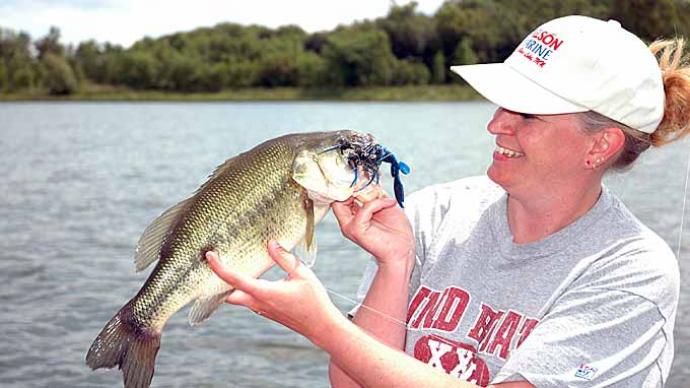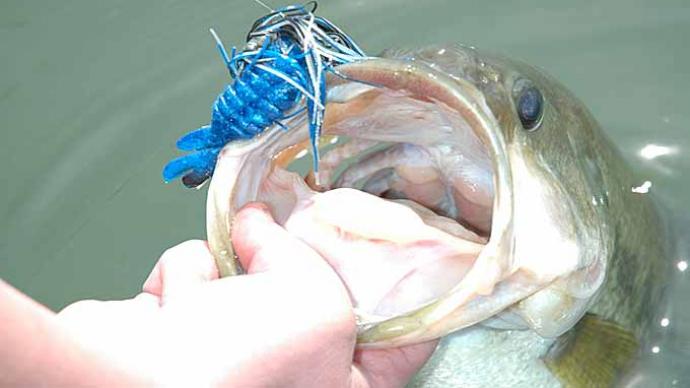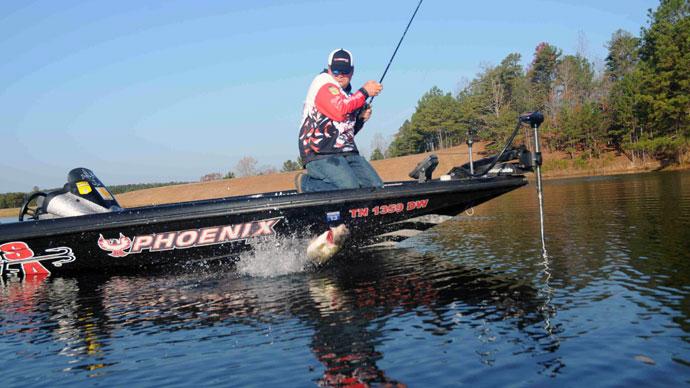


It's time to slow down our presentation as the water cools and look to the jig or a Texas-rigged worm or craw on those really cold days. Bass will move deeper as the water cools, establishing their winter base of operations. The deeper coves with a defined creek channel, longer points that drop off into secondary or primary creek channels, or shorelines where the bottom has a fast drop-off, causing a stair-step effect, are the best places to start exploring for action. The other primary factor that needs to be in all of these spots is wood. Bass tend to prefer wood in the colder months.
You want to find creek edges with trees along them, tree lines running down points into deep water, and stumps or brush piles along contour steps going into deep water. Boat docks with wood pilings going into deeper water are also good.
If activity on the upper end of the lake begins to slow, it may be due to water temperature. Go down the lake toward the dam and deeper water. The deeper areas of the lake will cool more slowly and are less affected by air temperature changes from cold fronts than the upper end or shallower areas of the lake. There can be as much as 10 degrees in temperature difference from the upper end of the lake to the dam. Try looking for areas with warmer water; it will improve your chances of catching fish.
Jigs come in several different styles, sizes, colors, and skirt combinations. The head shapes include oval, bullet, round, football, and stand-up style heads. Most have some type of weed guard, such as a fiber brush, plastic brush, or metal spring, to keep the hook from snagging as you bring the bait through the cover. The football head is supposed to work better in rocky areas without getting hung up. I typically prefer either the bullet or oval head.
Most skirts now are made of live rubber or silicone, in solid colors or a combination of strands, to give you a variety of colors. The fish scale skirts give the lure an added dimension of a fish or shad appearance. The primary colors I would suggest are black and blue, black and green, blue, green, green pumpkin, and junebug. These colors hold their color integrity in deeper water more than any other color.
You can add a pork or plastic trailer to give the jig some bulk in size and length. Use a color that matches or enhances the jig color. Pork will dry out in the air, so keep it moist.
A 1/2-ounce jig is a good starting point in weight. You need to use as light a weight as possible for the conditions and depth you are fishing, and still have the feel of the jig as it moves through the cover. In deeper water, I've used up to a 2-ounce jig in the wind to maintain contact. You need to feel the jig as it bumps into limbs, rocks, or snags along the bottom.
Before you fish the jig, you need to sharpen the hooks. After you sharpen the point, place it lightly on your thumbnail, pull it straight out; it should not slide at all if it is sharp. I also like to spray my jigs with the new Kick'n Bass scent for added appeal.
The line you use needs to be at least 17-pound monofilament, and some anglers prefer to use braided line for their jig fishing. The average rod length for jig fishing is 6' 10" to 7' 6", in a medium-heavy to heavy action. You need this stiffness to get a good hook set. The reel needs to be a high-speed 7:1 to take up excess line, get the bass away from the wood fast, and keep from getting wrapped up and losing the catch. I use a 6' 10" heavy-action Falcon Rod with a Shimano Curado reel and 25-pound Berkley Big Game in Low-Vis Green.
Fishing with a jig takes a lot of patience. You not only need to stay in touch with the bait and everything it touches, but you also need to concentrate on the line as it moves into the water. The bass will grab the jig on the fall, and all that will indicate that the bass has the lure is the twitch or movement of the line to the side, set the hook. Other times, all you will feel is the jig getting heavy. For some reason, bass will pick up and hold a jig in their mouth without moving or just slowly move away. You typically don't get the strike or jerk that you feel with other lures. Try to place the jig as close to the wood as possible, even if it means bumping the stump.
Work a jig like you would a Texas-rigged worm. Drop the jig past the wood, bring it up to the wood with a couple of hops by lifting the rod a couple of feet, then back down (like from 9:00 to 11:00 and back to 9:00). Then take up the excess line, watching the line as the jig falls. When you get to the wood, hop the jig a couple more times, reel it in, and flip it out again. Work all sides several times, and then move to the next spot.
This has been a short run-through on jig fishing. The best way to learn is to take nothing but a jig out to the lake and put all of your concentration into visualizing the jig as it moves along the bottom past the wood and into that lunker's mouth.