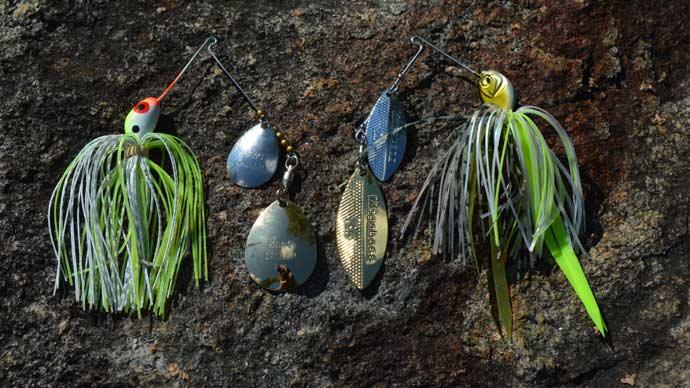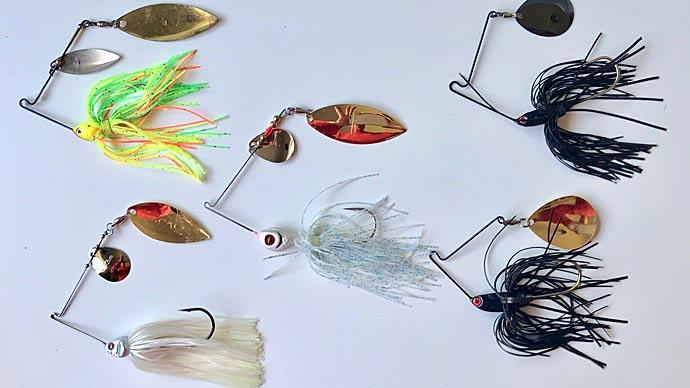


Spinnerbaits are often referred to as "the most versatile" lure because they can be fished in nearly any condition, year-round. They can be fished in winter, summer, fall, spring, hot water, cold water, muddy water, and even clear water from just under the surface to as deep as you want to fish it. It is also the type of lure that can be fished in, over, through, and around many cover forms.
Spinnerbaits used to be called "safety-pin" lures because their shape resembles an open safety pin. A lead head of varying weight is combined with a wire framework, a sharp hook, and one or more flashing spinner blades. A soft rubber, plastic, silicone, or "lumaflex" skirt is added to cover the hook. The spinnerbait has a smooth, flowing action that mimics a swimming baitfish. The blades vibrate and flash, attracting the attention of bass. You can use spinnerbaits in most bass-fishing situations, but they are especially suited to fishing shallow cover. The most popular sizes range between 1/4-ounce and 3/4-ounce.
Spinnerbait Designs
| Short-arm: | The length of the top wire arm is shortened. It can be fished anywhere but is especially suitable for dropping or "helicoptering" off ledges. |
| Long-arm: | The length of the top wire arm is lengthened. It can be fished anywhere, but is especially suitable for areas with grass or brushy cover. |
| Twinspins: | It works best on the bottom or as a drop bait. |
Techniques
Spinnerbaits work best as a "contact lure" that is bumped against structure. They usually should be fished at a slow to medium retrieve. Use 14-pound test line or better on a baitcasting reel and medium-action rod. A heavy, worm-type rod often causes you to overreact when a strike occurs, pulling the lure from the mouth of the bass. After the lure enters the water, give it a little "pop" to get the blades moving. Always fish the spinnerbait near the surface (close enough so you can see it). If you have to catch fish with it out of sight, there's a better bait (such as a worm). Note what you were doing when a bass hits - then try to duplicate it. A fast retrieve, in which the lure remains high and in sight in murky water, often produces well on feeding fish.
The best advice for fishing with spinnerbaits is to experiment with many different retrieve styles. No single method works all of the time. On any given day, you should switch around with your retrieve until you find something that works. Stick with it until it stops working, and then try another method.
Experiment with these different retrieves:
Contact: Locate a shallow creek arm or flat with stumps, grass, brush, or weed cover. (Polarized sunglasses will help you detect submerged cover.) Cast well past your target and retrieve the spinnerbait slowly. Try to knock the lure against the stump, brush, or grass you're fishing. This slight change in direction and action of the bait often triggers a strike.
Wake: In murky, shallow water, cast past a logjam or other heavy cover, raise the rod tip high, and reel quickly. The spinnerbait will rise to the surface. Slow the retrieve slightly so that the blades do not break the surface of the water. The lure will throw a fish-attracting wake.
Buzz: In murky, shallow water, reel quickly with the rod tip held high; let the blades of the bait break the surface, creating a splashing sound.
Helicopter: When fishing steep banks, ledges, or drop-offs, let the lure sink to the bottom on a tight line. The spinner blade will rotate as the bait drops. When it hits the bottom, reel in the slack, raise the rod tip slightly, and drop it again.
Slow-Roll: When bass are hiding fairly deep along drop-offs or submerged cover, cast toward shallow water, point the rod tip down, and retrieve very slowly, just fast enough for the blades to turn, so the bait will sink as it swims. A heavy bait (3/4 to 1 ounce) is most effective.
Blades
Need help deciding which blades to use? Use these guidelines:
| Single Blade: | Single-blade designs often perform better in deeper, clearer water or when fish aren't actively feeding. In cold water, use blades that create the most water resistance because this allows for a slower presentation. Use single blades for more vibration in low-light conditions and heavily stained water. In real muddy water, use a 1/2-ounce bait with a big blade. |
| Tandem Blade: | Tandem-blade spinnerbaits often work best in murky water or when fishing over grass or thick cover. For more flash, use tandem blades (use two blades of different colors). In visibility of 2 feet or more, use a 1/4 ounce bait with tandem willowleaf blades. |
| Colorado: | Use Colorado blades for bass in early prespawn, for pressured bass, and sluggish bass in shallow water. They produce the most vibration, making them ideal for fishing deep, in murky water, or at night. |
| Indiana: | Looking much like a pear, these blades fall between Colorado and willowleaf blades. This shape adds flash and decreases vibration. In addition, they can be fished faster than Colorado blades, making them better suited for active bass in stained-to-clear water. |
| Willowleaf: | For vegetation, willow blades are best. Their long, thin profile makes them snag-resistant and weed-resistant. They create a lot of flash, which imitates a baitfish. If everybody is using willowleaf blades, use a different blade to give the fish a different look. |
| Blade Colors: | Most fishermen begin with silver blades in clear water and gold or copper blades in murky water. Clear water and shallow fish may require a switch to white blades to reduce flash. Or try plastic blades with a hint of metal flake. Use colored blades for smallmouths, especially chartreuse or white, even in crystal-clear water. |
You can use large blades with small baits (1/4 ounce) and small blades with larger baits (1/2 ounce or more). For example, in windy conditions, when the forage is small baitfish, use a 1/2 ounce bait (to throw against the wind) with small blades (to match the forage). Use large blades on small baits to give it a slow fall.
The blades should run directly above the hook. If they're not, bend the wire until they do.
Tips
- Always cast underhand for the best presentation.
- Spinnerbaits should be among the first baits you use in the spring. They are especially well-suited to cold water. They also work well in warm, murky water.
- A little red somewhere on the spinnerbait usually is an asset.
- Spinnerbaits are excellent night-fishing lures. Wear a contrasting dark-colored skirt at night, such as black and purple, or red and black.
- For daytime fishing, light colors such as white and chartreuse are often most effective.
- Add a plastic or pork trailer to a spinnerbait for more appeal, buoyancy, and lift.
- Add a trailer hook to the spinnerbait's hook to catch short-striking fish.
- If the terrain permits, reverse the trailer hook for a better strike-catch ratio.
- Get spare spinnerbait skirts and blades and experiment with various colors, sizes, and blade shapes without buying many different lures.
- Experiment with bright, flashy colors. Sometimes, bass will annihilate them.
- Whenever you detect a pause in the beat of a blade, set the hook.
- Don't scrimp on spinnerbaits. Instead, buy the best you can. Quality spinnerbaits use ball-bearing swivels and high-quality hooks.
- Try casting onto the shore and gently pulling the lure into the water for a quieter presentation.
- When hunting for tackle, do not forget your local bait shops. Often, they will stock items more suited for the surrounding waterways. Larger chain stores often have a selection that is not tailored to local waters but instead designed for ease of restocking across multiple stores. Tackle shop owners have a better working knowledge of the area and a desire to stock and sell items that work. They also help to ensure a strong fishing community by sponsoring and organizing tournaments and clubs. Another critical point is that most chain stores do not offer live bait. If you go to Wal-Mart every time you need some tackle, the next time you head to your bait shop, it may not be there. Do not underestimate the importance of your business to these local shop owners. -- Arlen Ledbetter
- When fishing in a small shallow river, use a 1/4-ounce white Rooster Tail near brush piles. Let the bait fall close to the rocks and retrieve it slowly. This is a good hint for catching big smallmouth bass. -- Joshua